لغة انجليزية 02
Aperçu des sections
-
-

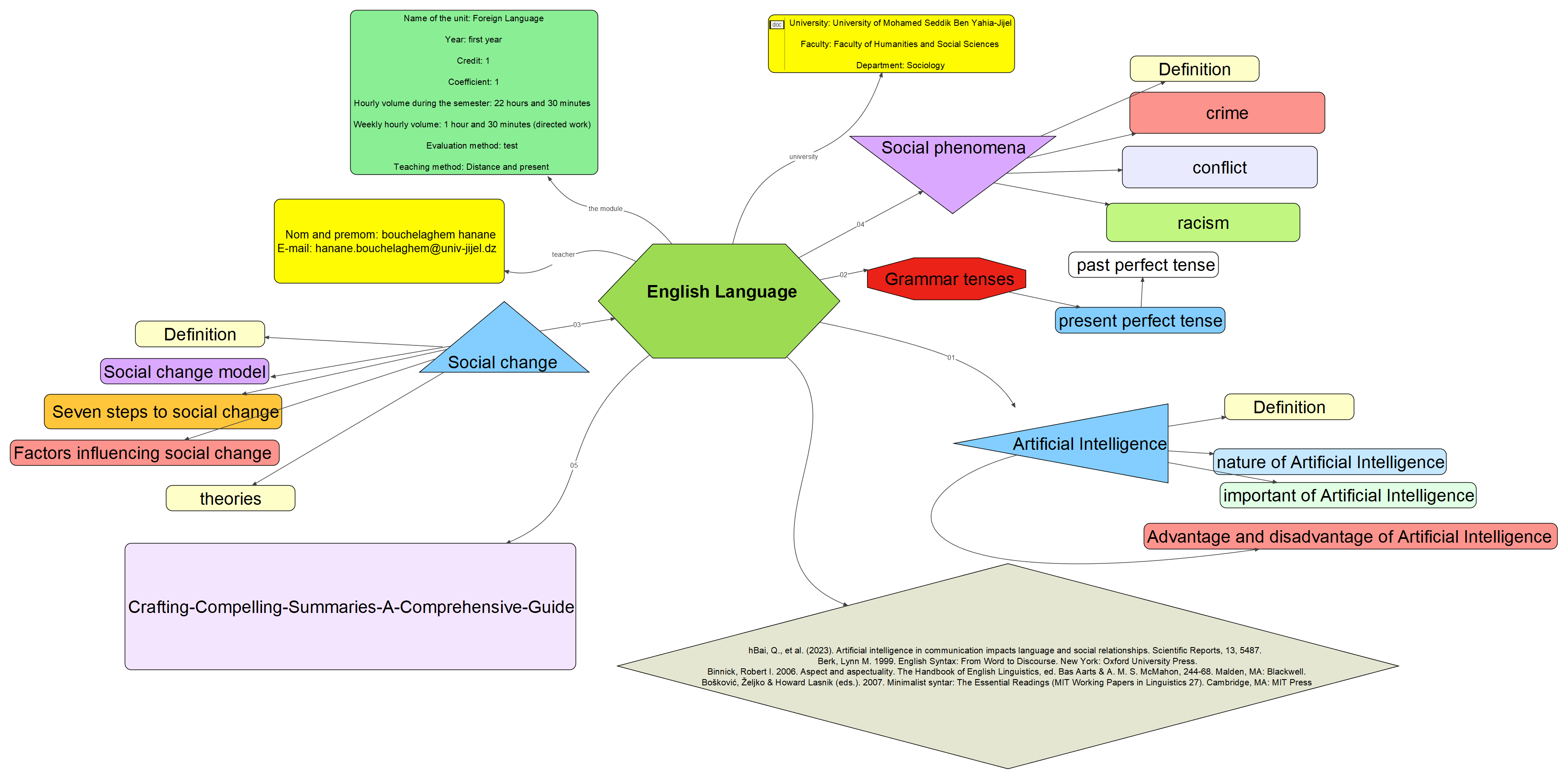
Name of the module : Foreign Language
University: University of Mohamed Seddik Ben Yahia-Jijel
Faculty: Faculty of Humanities and Social Sciences
Department: Sociology
Year: Second year of Bachelor's
Unit: Horizontal Education
Credit: 01
Coefficient: 01
Hourly volume during the semester: 22 hours and 30 minutes
Weekly hourly volume: 1 hour and 30 minutes (directed work)
Evaluation method: Continuous monitoring
Teaching method: Distance
2. Information about the module Teacher

Nom and premom: bouchelaghem hanane
E-mail: hanane.bouchelaghem@univ-jijel.dz
-
-
1. Understanding the Present Perfect and Past Perfect Tenses.
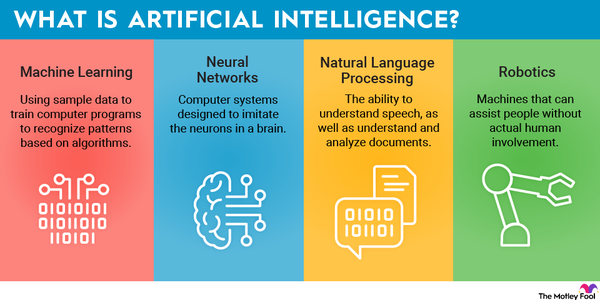
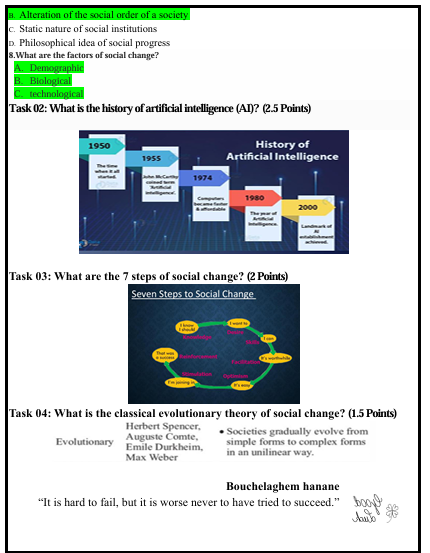
2. Knowledge of Artificial Intelligence: Its History, Advantages, and Disadvantages.
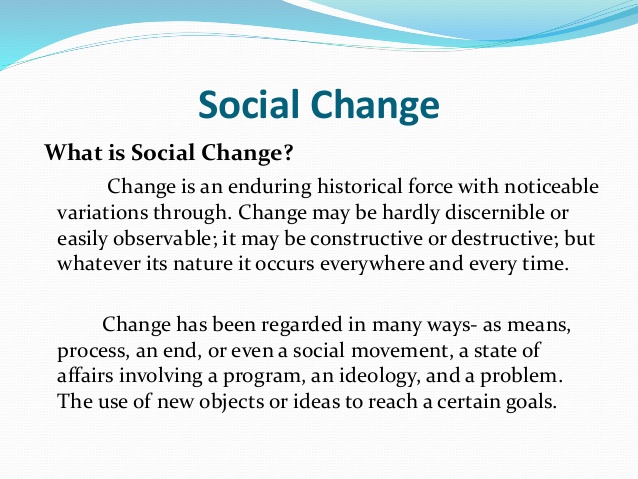
3. Exploring the Phenomenon of Social Change.
4. Understanding Social Phenomena.
5. Conducting Activities on Sociologists.

-
-
1. What is the full form of “AI”?
a) Artificially Intelligent
b) Artificial Intelligence
c) Artificially Intelligence
d) Advanced Intelligence2. What is Artificial Intelligence?
a) Artificial Intelligence is a field that aims to make humans more intelligent
b) Artificial Intelligence is a field that aims to improve the security
c) Artificial Intelligence is a field that aims to develop intelligent machines
d) Artificial Intelligence is a field that aims to mine the data3. Who is the inventor of Artificial Intelligence?
a) Geoffrey Hinton
b) Andrew Ng
c) John McCarthy
d) Jürgen Schmidhuber4. Which of the following is the branch of Artificial Intelligence?
a) Machine Learning
b) Cyber forensics
c) Full-Stack Developer
d) Network Design5. What is the goal of Artificial Intelligence?
a) To solve artificial problems
b) To extract scientific causes
c) To explain various sorts of intelligence
d) To solve real-world problems6. Which of the following is an application of Artificial Intelligence
a) It helps to exploit vulnerabilities to secure the firm
b) Language understanding and problem-solving (Text analytics and NLP)
c) Easy to create a website
d) It helps to deploy applications on the cloud7. In how many categories process of Artificial Intelligence is categorized?
a) categorized into 5 categories
b) processes are categorized based on the input provided
c) categorized into 3 categories
d) process is not categorized8. Based on which of the following parameter Artificial Intelligence is categorized?
a) Based on functionally only
b) Based on capabilities only
c) Based on capabilities and functionally
d) It is not categorized9. Which of the following is a component of Artificial Intelligence?
a) Learning
b) Training
c) Designing
d) Puzzling10. What is the function of an Artificial Intelligence “Agent”?
a) Mapping of goal sequence to an action
b) Work without the direct interference of the people
c) Mapping of precept sequence to an action
d) Mapping of environment sequence to an action
-


-
Example Paragraph (Topic: Social Media and Collective Identity)
Sociologists have long examined how collective identities are formed. Before the digital age, these identities had been shaped primarily by local communities, shared physical spaces, and traditional media. However, the rise of social platforms has fundamentally altered this process. Online, individuals have curated new forms of belonging that transcend geography. By the time researchers began serious study of "digital tribes" in the 2010s, social media had already become a primary arena for identity performance. This shift has created unprecedented networks, but it has also raised new questions about the depth and durability of these digitally-mediated bonds.
-
-
Ouvert le : vendredi 28 février 2025, 00:00À rendre : vendredi 7 mars 2025, 00:00
Fill in the blanks with Present Perfect or Past Perfect Tenses
2. Her wounds (heal) almost completely. She can start exercising as early as tomorrow.
1. John (visit) me that day before you called.
3. Did you hear that Ben was fired last month even though he (work) in almost every department?
4. I (see) many pictures of the pyramids before I went to Egypt last summer. Pictures are a little misleading, they are smaller than they look.
5. Sarah (climb) Mount Everest. She is such an adventurous person.
6. Susan (climb) Mount Everest and had sailed around the world by the time she was twenty-five.
7. Before my trip to Paris two years ago, I (never be) to France.
8. When we finally stopped him, the squirrel (already eat) twenty nuts.
9. We need more time because Alen (just finish) the painting, but he hasn't done the decorating yet.
10. I am so tired. I (run) 5 miles today.
-
-

https://youtu.be/vGJ3KEuwSTg?si=GGxOCPReRYtQKGRA
-

Social phenomena are observable occurrences that result from interactions between individuals and their environment, including social structures and cultural contexts. They encompass a wide range of behaviors, actions, and events influenced by social, historical, and individual factors. Essentially, they are the patterns and happenings within society that arise from how people relate to one another and their surroundings.

-
Social phenomena are observable facts, events, or behaviors that arise from the interactions of individuals within a society or group. They are the patterns and forces that emerge when people live together, communicate, and form relationships, often taking on a life of their own beyond the intentions of any single person.
-

Crafting a compelling summary involves identifying the main points of a text and rewriting them concisely in your own words. It should be clear, concise, and objective, avoiding personal opinions or interpretations. Effective summaries highlight the core message and supporting details, making the original text accessible to a wider audience
Crafting the Compelling Summary - A Step-by-Step Guide
Here's how to summarize Chen's work effectively, from a short abstract to a more detailed paragraph.
Step 1: Identify the Core Elements (The “Anatomy”)
· Author & Source: Dr. Elena M. Chen, The Digital Divide: Connectivity and Inequality...
· Central Argument/Thesis: The digital divide is a complex system of digital stratification that reinforces inequality.
· Key Concepts: Digital stratification, precarious connectivity, capital-enhancing activities.
· Methodology: 5-year mixed-methods study in "Port Carlyle."
· Main Conclusion/Implication: The divide is a core dimension of social stratification; policy needs a holistic approach.
Step 2: Choose Your Length and Purpose
A. The One-Sentence Summary (The "Elevator Pitch"):
In The Digital Divide, sociologist Elena Chen reconceptualizes the digital divide not as a simple gap in access, but as a pervasive system of digital stratification that reinforces existing social inequalities based on class, race, and place.
Why it works: It names the author, source, and the single most important idea (the shift from “access” to “stratification”).
B. The Paragraph Summary (Common for literature reviews):
In her seminal study The Digital Divide: Connectivity and Inequality in the 21st Century Metropolis, Dr. Elena Chen argues that the contemporary digital landscape is defined by a deep digital stratification, moving beyond simplistic metrics of access. Through a five-year mixed-methods study in "Port Carlyle," she demonstrates how marginalized communities experience "precarious connectivity"—relying on slower, mobile-only access with less institutional support—while affluent groups use high-speed broadband for capital-enhancing activities like education and career advancement. Chen concludes that this divide constitutes a fundamental axis of social inequality and calls for policies addressing literacy, affordability, and quality, not just infrastructure.
Why it works:
1. First Sentence: Establishes author, source, and core thesis.
2. Middle Sentences: Introduce key evidence (the study, the concept of "precarious connectivity") and the mechanism of inequality.
3. Final Sentence: States the broader conclusion and implication. It uses strong sociological language ("axis of social inequality").
C. The Bulleted Summary (For notes or presentation slides):
· Thesis: The digital divide is a system of digital stratification, not just an access gap.
· Key Concept: “Precarious Connectivity” – the unstable, limited, and costly internet access of marginalized groups.
· Evidence: Comparative study in "Port Carlyle" found disparities in:
· Quality: Smartphones vs. broadband.
· Support: Lack of institutional digital literacy training.
· Use: Entertainment vs. economic/educational advancement.
· Conclusion: Digital stratification is a core dimension of social inequality.
· Policy Implication: Need holistic strategies beyond infrastructure.
Step 3: Apply the “DOs and DON’Ts” of Compelling Summaries"
Connect to the Broader Field Don't treat the work as isolated. (In a longer summary, you can hint at this). We might add: "Her work challenges earlier 'access-focused' models (eg, NTIA, 1990s) and aligns with later critical theories of technology."
Step 4: Inject "Compelling" Elements (What Makes it Stand Out?)
A summary becomes compelling when it does more than just report; it connects and synthesizes.
· Highlight the "So What?": Chen isn't just describing a problem; she's redefining a core concept (from "divide" to "stratification"), which changes how we research and solve it.
-
Write an article about a pioneer of sociology
Very important note: It is necessary to document and write references. Relying on artificial intelligence gives 0 direct l y .
Introduction

A brief biography of the writer
His works
His most important works in the sociological field
Conclusion
-
-
يرسل العمل للإيميل Hanane.bouchelaghem@univ-jijel.dz
بداية الإمتحان: الجمعة 2 ماي 2025
نهاية الإمتحان: الإثنين 5 ماي 2025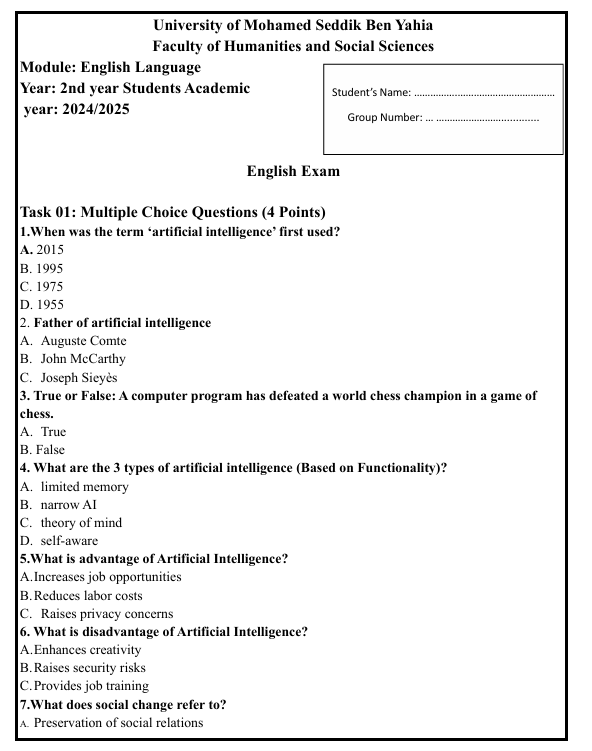
-

-
- Bai, Q., et al. (2023). Artificial intelligence in communication impacts language and social relationships. Scientific Reports, 13, 5487.
- Berk, Lynn M. 1999. English Syntax: From Word to Discourse. New York: Oxford University Press.
- Binnick, Robert I. 2006. Aspect and aspectuality. The Handbook of English Linguistics, ed. Bas Aarts & A. M. S. McMahon, 244-68. Malden, MA: Blackwell.
- Bošković, Željko & Howard Lasnik (eds.). 2007. Minimalist syntar: The Essential Readings (MIT Working Papers in Linguistics 27). Cambridge, MA: MIT Press.
- Börjars, Kersti & Kate Burridge. 2001. Introducing English Grammar. London: Arnold Publishers.
- Bragg, Melvyn. 2006. The Adventure of English: The Biography of a Language (paperback edition). New York: Arcade Publishing
- Hsu, T.W., & Chang, H.Y. (2020). The impact of artificial intelligence on human society and bioethics. Tzu Chi Medical Journal, 32(4), 339–343
- Gerlich, M. (2025). AI Tools in Society: Impacts on Cognitive Offloading and the Future of Critical Thinking. Societies, 15(1), 6.