لغة انجليزية
Aperçu des sections
-
- Information about the module

Name of the module: English language
University: University of Mohamed Seddik Ben Yahia-Jijel
Faculty: Faculty of Humanities and Social Sciences
Department: Sociology
Year: Second year
Unit: Horizontal Education
Credit: 01
Coefficient: 01
Hourly volume during the semester: 22 hours and 30 minutes
Weekly hourly volume: 1 hour and 30 minutes (directed work)
Evaluation method: Continuous monitoring
Teaching method: Distance
2. Information about the module Teacher

Nom and premom: bouchelaghem hanane
E-mail: hanane.bouchelaghem@univ-jijel.dz
-

-

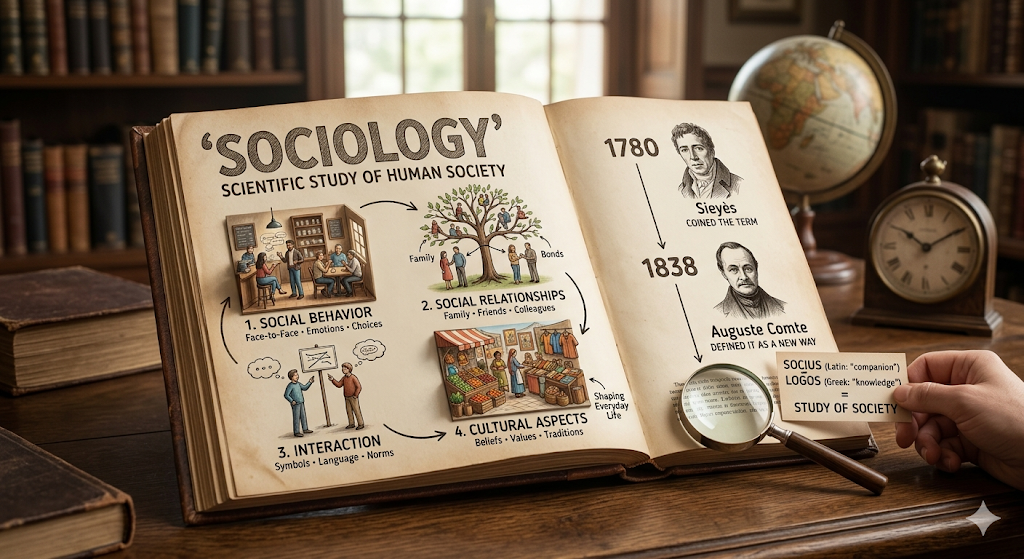
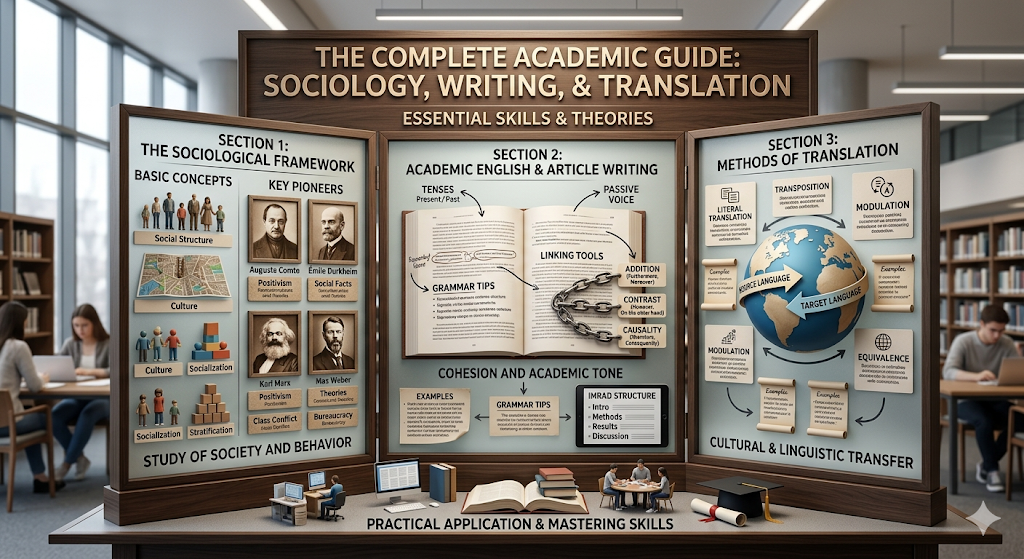
Learn what sociology is.Learn the basic concepts in sociology.Know the most important pioneers of sociology.Understand some rules in the English language.Learn how to write an article in a foreign language.Know the linking tools used in writing a scientific article.
Students learn the methods andways of translation from and to a foreign language.
English Language Skills for Sociologists
- Grammar: Mastery of tenses such as Simple Present, Past, and Future, as well as Present and Past Perfect.
- Academic Writing: Learning how to write research articles and summaries. This involves using linking words (discourse markers) like whereby, while, therefore, and for example to create logical flow in sociological arguments.
- Research Ethics: A specific emphasis is placed on documenting references and avoiding the use of artificial intelligence, which is strictly prohibited for assignments.
-
-
-
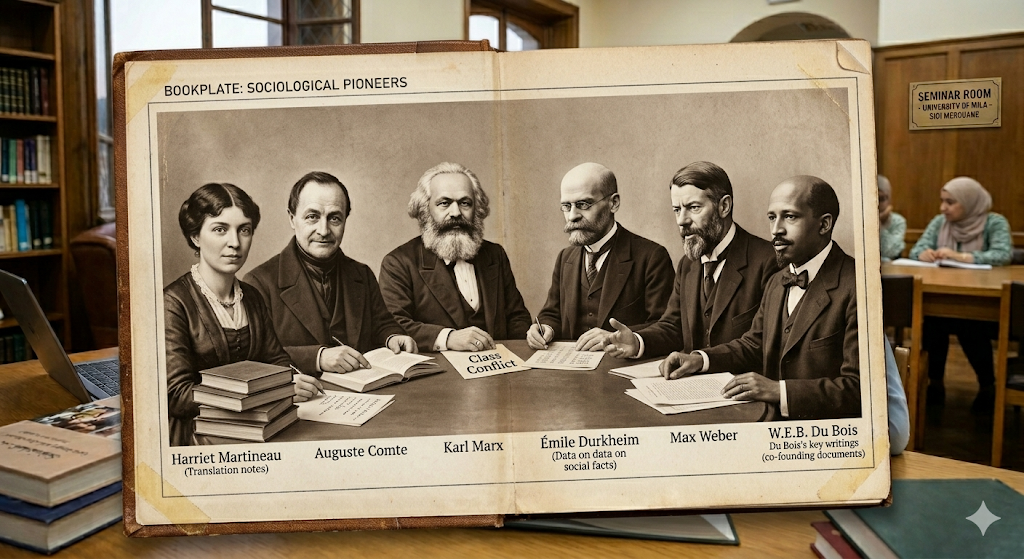
- · Auguste Comte: Coined the term "sociology" and advocated for the scientific study of society.
- · Karl Marx: Analyzed class conflict and the economic foundations of society.
- · Émile Durkheim: Pioneered the study of social facts, solidarity, and suicide.
- · Max Weber: Emphasized the role of culture, ideas, and bureaucracy in social change.
- · W.E.B. Du Bois: Pioneered empirical studies of race and African American life, and co-founded the NAACP.
- · Harriet Martineau: Early translator of Comte and analyst of American society, gender, and political economy.
-
? Write an article about a pioneer of sociology

Very important note: It is necessary to document and write references. Relying on artificial intelligence gives 0 directly.
Introduction
A brief biography of the writer
His works
His most important works in the sociological field
Conclusion
-

Tense
Form
Example
Main Use
Verb (+s/es for he/she/it)
"He plays soccer."
Habits, facts, general truths.
Verb + -ed (or irregular form)
"He played soccer."
Completed action in the past.
Will + Verb / Be going to + Verb
"He will play soccer." / "He is going to play soccer."
Something that will happen after now.
-
Ouvert le : lundi 11 novembre 2024, 00:00À rendre : mardi 19 novembre 2024, 00:00
-
-
-
Ouvert le : mercredi 20 novembre 2024, 00:00À rendre : mercredi 27 novembre 2024, 00:00
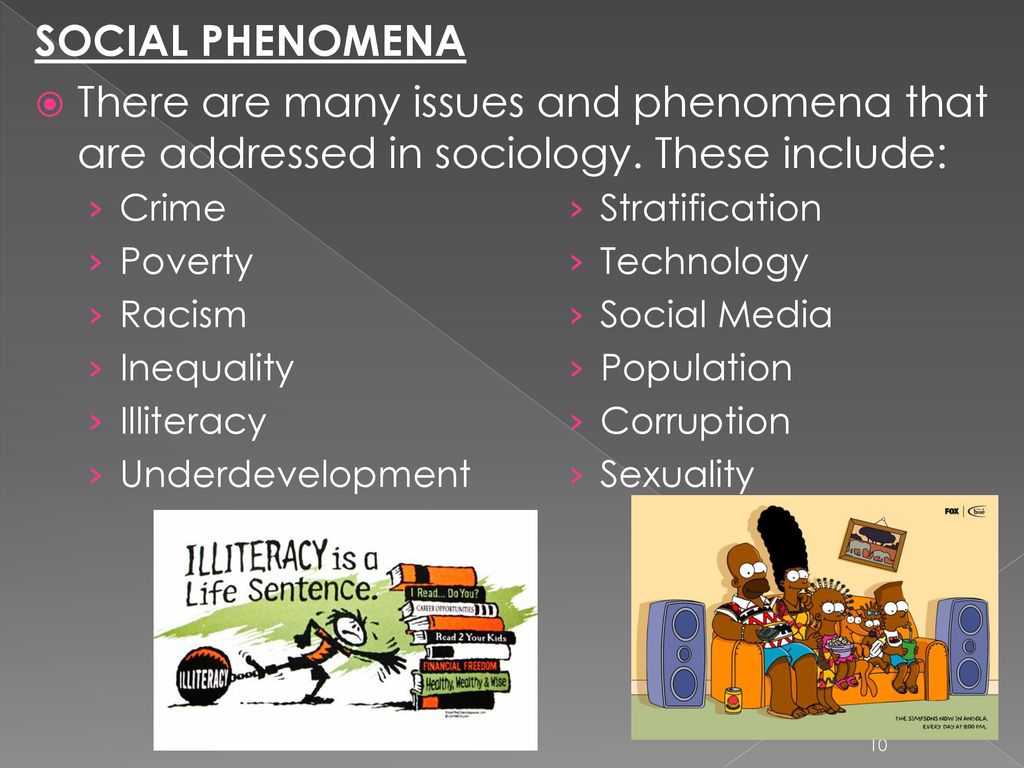
Write an article or research about a social phenomenon?
-
-
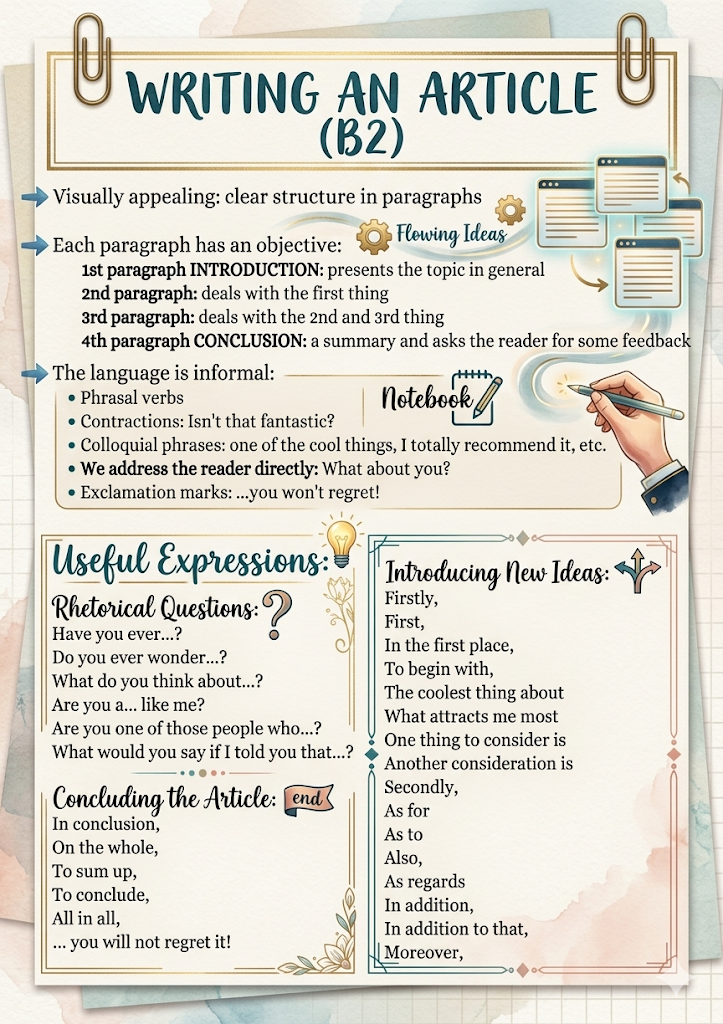
Writing a sociology article involves a specific way of thinking and a structured approach. Here’s a
comprehensive guide, from conception to final draft.Rhetorical Questions
Introducing New Ideas
Concluding the Article
Have you ever...?
Firstly / To begin with...
In conclusion...
Do you ever wonder...?
The coolest thing about...
On the whole...
What do you think about...?
What attracts me most...
To sum up...
Are you a... like me?
Another consideration is...
All in all...
What would you say if I told you...?
In addition to that...
...you will not regret it!
-
Ouvert le : mercredi 17 décembre 2025, 00:00À rendre : mercredi 24 décembre 2025, 00:00
Example Outline: A Short Article on Remote Work
· Title: "Blurred Boundaries: A Qualitative Study of Gender Dynamics in Remote Work During the COVID-19 Pandemic"
· Intro: Rise of remote work, promise of flexibility, but potential to reinforce traditional gender roles.
· Lit. Review/Theory: Review of gender division of labor (Hochschild's "second shift"); concept of "boundary work."
· Methodology: In-depth interviews with 25 heterosexual dual-earner couples with children, conducted via Zoom.
· Findings:
· Theme 1: Women more often reported managing childcare interruptions.
· Theme 2: Home office spaces were gendered (his: dedicated room; hers: kitchen table).
· Discussion: Remote work did not dismantle gendered labor patterns but relocated and sometimes intensified them. Connects to theory of "flexibility stigma" and persistent cultural schemas.
· Conclusion: Without intentional policy and household negotiation, remote work may replicate old inequalities in new spaces. Suggests need for organizational and couple-level strategies.
-
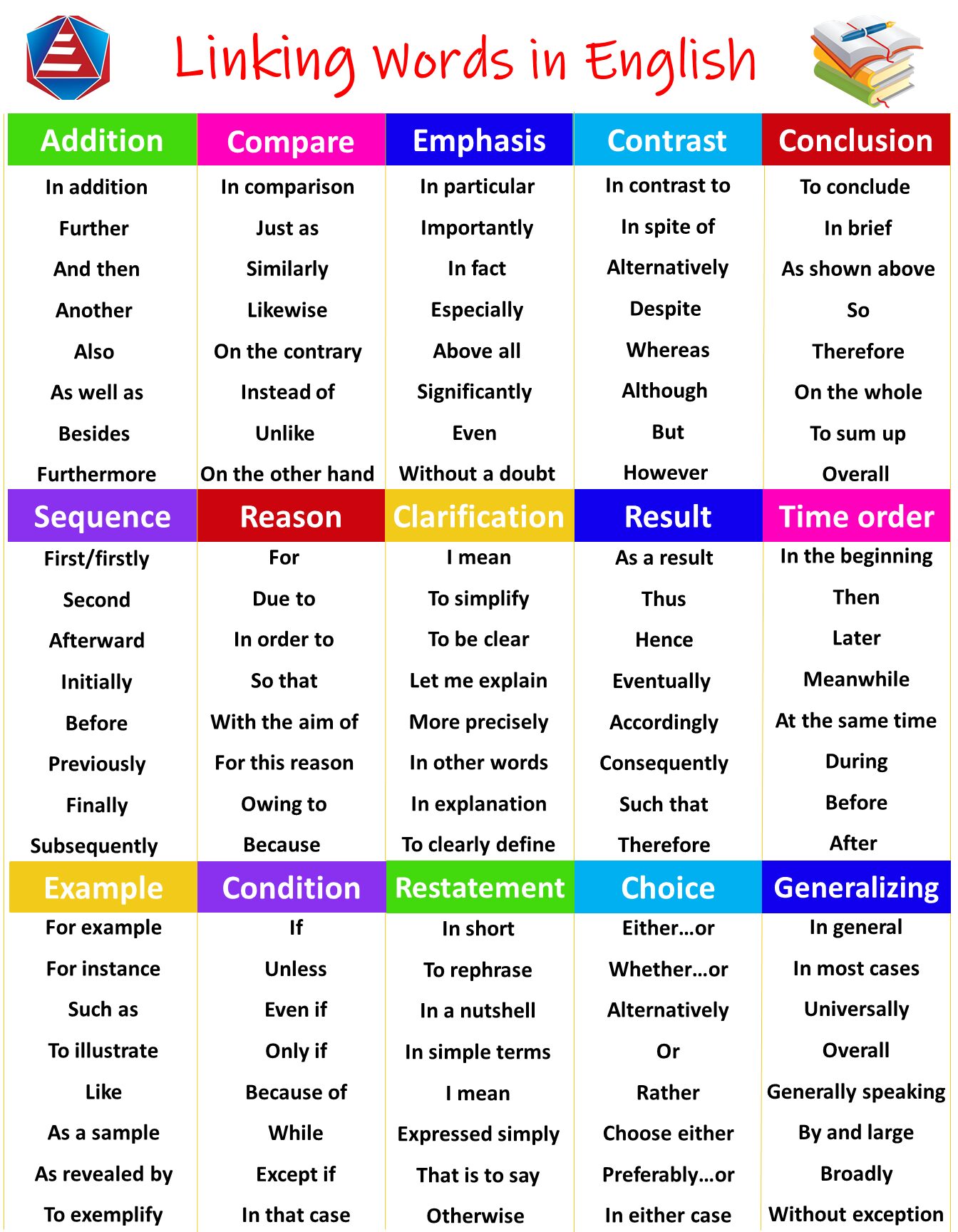
Here is a short paragraph on social stratification, written for sociology, with linking words in bold:
Social stratification is a fundamental characteristic of society, whereby individuals are hierarchically ranked. While some theories argue this ranking is based on merit, conflict theorists contend it primarily serves to maintain the power of dominant groups. Economic capital is a key determinant, but cultural and social capital are also crucial. For example, access to elite social networks can lead to better opportunities, thus reinforcing one's position. Therefore, stratification is not simply a natural order but rather a systemic process that perpetuates inequality across generations.
Key Linking Words Used:
· whereby: shows the method or manner.
· While: introduces a contrasting perspective.
· but / rather: signal a contradiction or clarification.
· also: adds a complementary point.
· For example: introduces specific evidence.
· thus / therefore: indicate a consequence or conclusion.
-
-
Choose the correct discourse markers to complete the sentences below.
1A: 'Did he look sad?' B: 'No, , he was really cheerful.'
2 your question about our mobile rates, I have attached a document where you can see all our rate plans.
3Well, I think we can declare the meeting closed. , who's going to have lunch at the canteen today?
4, the most qualified candidates always get the best jobs.
5I will help him, , he has always been there for me.
6The interiors are beautiful and , they have designed them themselves.
7The north of the country is industrialised and rich the south is quite poor, with an economy based on agriculture.
8, our objective is improving productivity and product quality at the same time.
9, we could say that the charity dinner was a success.
10We'd better find a quick solution to this crisis, our customers will start to lose faith in us.
-
-
-
1. Team Division: Divide the class into small groups (4-5 students each).
2. Topic Selection: Each group chooses a life theme to focus on, such as:
· University / School Life.
· Travel & Preparing for a Trip.
· Social Relationships (Friendship, Solving Problems).
· Work & Projects.
· Health & Sports.
· Technology & Social Media.
-
-
Summary writing is a technique to make the passage short and concise. This quiz will provide valuable tips on summary writing in the form of MCQs with answers. The quiz contains easy, medium, or hard questions that will ensure you get a grip on the art of summary writing. After taking the quiz, you will be well-versed with the concept and rules of summary writing. If you find the quiz helpful, share it with others. All the best!
-
-
-
Ouvert le : mercredi 19 février 2025, 00:00À rendre : mercredi 26 février 2025, 00:001. They (live) in Australia since 1989.
2. He (wait) for hours.
3. She (work) in this company for ten years.
4. They (go) on a trip to Jamaica before moving to Paris.
5. She (cut) her hair but she didn't like it.
6. Where (be/you) ?
7. They (study) Spanish for 5 years when at university.
8. He (work) here since last spring when he had an accident.
9. He (not go) to Spain since 1981 but he did last year.
10. I (read) this book for 4 hours.
11. My car (to steal).
12. They (not come) to his party because they were sick.
13. He (not teach) French till 2002 when he was asked to do so.
14. She (write) good books for years.
-
- Åfarli, T. A., & Mæhlum, B. (Eds.). (2014). The Sociolinguistics of Grammar. John Benjamins.
- Aarts, Bas. 2008. English Syntax and Argumentation (3rd edition). Houndmills and New York: Palgrave MacMillan.
- American Heritage. 2006. The American Heritage Dictionary of the English Language (4th edition). Boston and New York: Houghton Mifflin Company.
- Austin, J. L. 1965. How to Do Things with Words. Oxford University Press.
- Azar, Betty Schrampfer. 2002. Understanding and Using English Grammar (3rd edition). Pearson Longman.
- Bailey, Charles James Nice. 1996. Essays on Time-Based Linguistic Analysis. Oxford: Clarendon Press; New York: Oxford University Press.
- Baugh, Albert C. 1963. A History of the English Language (2nd edition). New York: Appleton-Century-Crofts
- · Fishman, J. A., & García, O. (Eds.). (2010). The Handbook of Language and Ethnic Identity (2nd ed.). Oxford University Press.
- · Ehrlich, S., Meyerhoff, M., & Holmes, J. (Eds.). (2014). The Handbook of Language, Gende and Sexuality (2nd ed.). .